
Introduction
Many SaaS businesses struggle to generate consistent leads while dealing with rising customer acquisition costs (CAC), making sustainable growth feel difficult and unpredictable. This is where B2B SaaS marketing strategies come into play. In simple terms, B2B SaaS marketing is the process of promoting cloud-based software solutions to other businesses in a way that attracts the right audience and converts them into long-term customers. However, without the right approach, many companies fail to reach decision-makers, generate quality leads, or turn trials into paying users.
In this guide, you’ll learn how B2B SaaS marketing actually works, which strategies drive high-quality leads, and how you can build a scalable system that not only reduces acquisition costs but also helps you grow your business faster and more consistently.
What is b2b saas Marketing
B2B SaaS marketing is the process of promoting cloud-based software products to other businesses using targeted SaaS marketing strategies that focus on generating leads, building trust, and driving long-term subscriptions. Unlike one-time sales, it’s all about creating a system that consistently attracts the right companies and converts them into loyal customers.
The key difference between B2B SaaS marketing and B2C SaaS marketing is the audience and buying process. In B2C, you sell directly to individuals with quick decisions, while in B2B software marketing, you target businesses where decisions involve multiple stakeholders, longer sales cycles, and a stronger focus on ROI and value.
This is why B2B SaaS marketing is so important for growth. It helps companies reach the right decision-makers, generate high-quality leads, reduce customer acquisition costs, and build a scalable revenue model through recurring subscriptions.
⚙️ How B2B SaaS Marketing Works
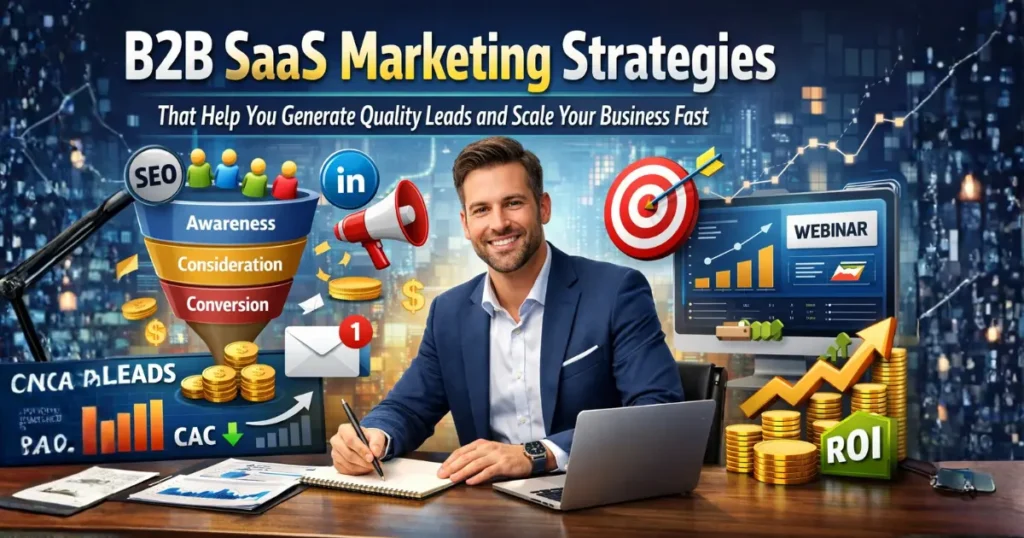
B2B SaaS marketing works through a structured funnel that guides businesses from discovering your product to becoming long-term paying customers. Instead of quick decisions, it focuses on building trust, delivering value, and nurturing leads at every stage.
🔍 Awareness
This is where potential customers first discover your product through channels like SEO, blogs, LinkedIn, or ads. The goal is to attract the right audience by solving their problems or answering their questions.
📚 Consideration
At this stage, businesses start evaluating your software. They read case studies, compare tools, and explore your content. Here, your SaaS marketing strategies should focus on building trust and showing how your product solves real business challenges.
💰 Conversion
Once trust is built, users are more likely to take action—such as signing up for a free trial or booking a demo. A smooth onboarding process and clear value proposition help turn leads into paying customers.
🔄 Retention
After conversion, the focus shifts to keeping customers engaged and satisfied. Good support, regular updates, and consistent value ensure long-term retention and recurring revenue.
🚀 Top B2B SaaS Marketing Strategies
To succeed in today’s competitive market, you need B2B SaaS growth strategies that not only attract traffic but also convert it into paying customers. The right mix of channels and tactics can help you improve SaaS lead generation, reduce acquisition costs, and build a scalable system for long-term growth. Here are the most effective strategies you should focus on:
1. 📚 Content Marketing & SEO
Content is the foundation of almost every successful B2B SaaS marketing strategy. By creating valuable and informative content, you can attract the right audience organically.
- Blogging: Write helpful articles that solve real problems your target audience is searching for.
- Keyword targeting: Focus on intent-based keywords like “best CRM for startups” or “SaaS lead generation tools.”
- Long-form content: In-depth guides (1000+ words) perform better in rankings and build authority.
👉 This strategy helps drive consistent traffic and improves SaaS customer acquisition over time.
2. ⚙️ Product-Led Growth (PLG)
Product-Led Growth is one of the most powerful B2B SaaS growth strategies because it lets your product sell itself.
- Free trial: Allow users to experience your product before making a decision.
- Freemium model: Offer a basic version for free to attract more users and convert them later.
👉 When users see real value, conversion becomes much easier and more natural.
3. 📩 Email Marketing
Email marketing is essential for nurturing leads and guiding them through the funnel.
- Lead nurturing: Send helpful content, tips, and updates to build trust over time.
- Automation: Use automated email sequences to engage users at the right moment.
👉 This helps turn cold leads into warm prospects and improves your overall SaaS lead generation efforts.
4. 💼 LinkedIn Marketing
Since LinkedIn is a professional platform, it’s perfect for B2B SaaS marketing.
- B2B audience targeting: Reach decision-makers like founders, managers, and executives.
- Personal branding: Share insights, case studies, and valuable content to build authority.
👉 Strong LinkedIn presence can directly impact your SaaS customer acquisition.
5. 💰 Paid Advertising
Paid ads help you get faster results and reach high-intent users.
- Google Ads: Target users actively searching for solutions.
- LinkedIn Ads: Run highly targeted campaigns for specific industries or job roles.
👉 This strategy is ideal for scaling your SaaS lead generation quickly.
6. 🎯 Account-Based Marketing (ABM)
ABM focuses on targeting high-value clients instead of a broad audience.
- Target high-value clients: Create personalized campaigns for specific companies or decision-makers.
👉 This approach improves conversion rates and is highly effective for enterprise-level B2B SaaS growth strategies.
⚡ Final Insight
The best results come when you combine these strategies instead of relying on just one. A balanced approach helps you build a strong pipeline, improve SaaS customer acquisition, and create a predictable growth system.
📢 Best Channels for B2B SaaS Marketing
To build a strong and scalable system, every B2B SaaS marketing agency uses a mix of high-performing channels. These channels help you reach the right audience, improve visibility, and drive consistent growth through B2B SaaS digital marketing efforts.
- SEO (Search Engine Optimization): The backbone of B2B SaaS content marketing, helping your website rank on Google and attract high-intent traffic.
- Email Marketing: A powerful way to nurture leads, build relationships, and guide users toward conversion.
- LinkedIn Marketing: Ideal for targeting professionals and decision-makers, making it a key channel in B2B SaaS marketing.
- Webinars: Great for educating your audience, showcasing your product, and building trust in real-time.
- Communities (Slack, Reddit, Forums): Engage with your audience, share insights, and stay updated with the latest B2B SaaS marketing news and trends.
👉 Using the right combination of these channels helps you create a strong and sustainable growth engine.
📈 Key Metrics You Must Track
In B2B SaaS marketing, tracking the right metrics is essential to understand what’s working and where to improve.
- CAC (Customer Acquisition Cost): The total cost required to acquire a new customer. Lower CAC means more efficient marketing.
- LTV (Lifetime Value): The total revenue you earn from a customer over time. Higher LTV indicates strong retention and value delivery.
- Conversion Rate: The percentage of visitors or leads who take action (like signing up or purchasing).
- Churn Rate: The rate at which customers stop using your product. Lower churn means better retention.
👉 These metrics help you optimize your B2B SaaS digital marketing strategies and improve profitability.
⚠️ Common Mistakes to Avoid
Even the best B2B SaaS marketing agency can fail if basic mistakes are ignored. Avoiding these can save time, money, and effort.
- Ignoring SEO: Without SEO, your B2B SaaS content marketing won’t reach the right audience.
- Targeting the wrong audience: Focusing on the wrong users leads to low-quality leads and poor conversions.
- No lead nurturing: Without follow-ups, most leads never convert into customers.
- Poor onboarding: If users don’t understand your product quickly, they are more likely to leave.
👉 Fixing these mistakes can significantly improve your B2B SaaS marketing performance.
💡 Pro Tips for Faster Growth
If you want to stay ahead in a competitive market, you need smart and practical B2B SaaS growth strategies.
- Focus on long-tail keywords: Easier to rank and bring high-intent traffic.
- Build topical authority: Cover your niche deeply to become a trusted source in B2B SaaS marketing.
- Use case studies: Real examples build trust and improve conversions.
- Optimize landing pages: A well-optimized page can significantly boost SaaS customer acquisition.
👉 These tips can help you scale your B2B SaaS digital marketing efforts faster.
🧩 Real-Life Example / Case Study
Let’s take a simple example of how B2B SaaS marketing works in action.
A SaaS company offering CRM software starts investing in B2B SaaS content marketing by publishing SEO-optimized blogs. Over time, they begin ranking for keywords like “best CRM for startups.” This drives consistent organic traffic. They then offer a free trial (Product-Led Growth), capture leads, and nurture them through email campaigns.
At the same time, they run LinkedIn campaigns targeting business owners and share insights regularly to build authority. By combining SEO, email, and LinkedIn strategies, they improve SaaS lead generation and reduce CAC. Eventually, more users convert into paying customers, and the company achieves steady, scalable growth.
👉 This is how a well-planned B2B SaaS digital marketing strategy turns traffic into long-term revenue.
❓ FAQs
Here are some commonly asked questions that help you better understand B2B SaaS marketing and improve your overall strategy:
1. What is B2B SaaS marketing?
B2B SaaS marketing is the process of promoting software products to other businesses using strategies like SEO, content marketing, email campaigns, and paid ads. The goal is to generate leads, convert them into customers, and build long-term recurring revenue.
2. How do SaaS companies generate leads?
SaaS companies use multiple channels such as SEO-driven content, LinkedIn marketing, paid ads, and email campaigns. These SaaS lead generation strategies help attract the right audience and convert them into potential customers.
3. Which channel is best for SaaS marketing?
There is no single “best” channel. A combination of SEO, email marketing, and LinkedIn works best for most businesses. Strong B2B SaaS digital marketing strategies focus on using multiple channels together for better results.
4. How long does SaaS marketing take to show results?
SaaS marketing is a long-term process. SEO and content marketing can take 3–6 months to show results, while paid ads can deliver quicker outcomes. Consistency is key for sustainable growth.
5. What is the role of content in B2B SaaS marketing?
Content plays a major role in building trust and authority. B2B SaaS content marketing helps educate users, answer their questions, and guide them through the buying journey.
6. How can a B2B SaaS marketing agency help?
A B2B SaaS marketing agency can help you create and execute effective strategies, manage campaigns, generate leads, and optimize performance to achieve faster growth.
7. What are the biggest challenges in B2B SaaS marketing?
Some common challenges include high competition, long sales cycles, high CAC, and converting free users into paying customers. Overcoming these requires strong planning and consistent execution.
🔚 Conclusion
B2B SaaS marketing is not just about promoting your product—it’s about building a complete system that attracts the right audience, nurtures leads, and turns them into long-term customers. By combining the right B2B SaaS digital marketing strategies like SEO, content marketing, email campaigns, and LinkedIn outreach, you can create a predictable growth engine for your business.
The key takeaway is simple: focus on providing value, understand your audience, and stay consistent with your efforts. Growth in SaaS doesn’t happen overnight, but with the right approach, it becomes scalable and sustainable.
